The Compounding Mathematics of Third-Party Contract Drift
In modern enterprise procurement architectures, an executed sales agreement is never an isolated legal instrument. It functions as a foundational node in an intricate web of supply-chain commitments, service-level guarantees, customer-data warranties, and downstream subcontracting obligations.
When an unauthorized clause alteration, silent redline drift, or fraudulent billing escalation infects a primary agreement, the exposure does not scale linearly. Instead, liability expands exponentially across every connected vendor integration, creating what forensic actuaries define as the Contract Leakage Multiplier (CLM).
Mathematical Proof of the 1.15x Compounding Factor
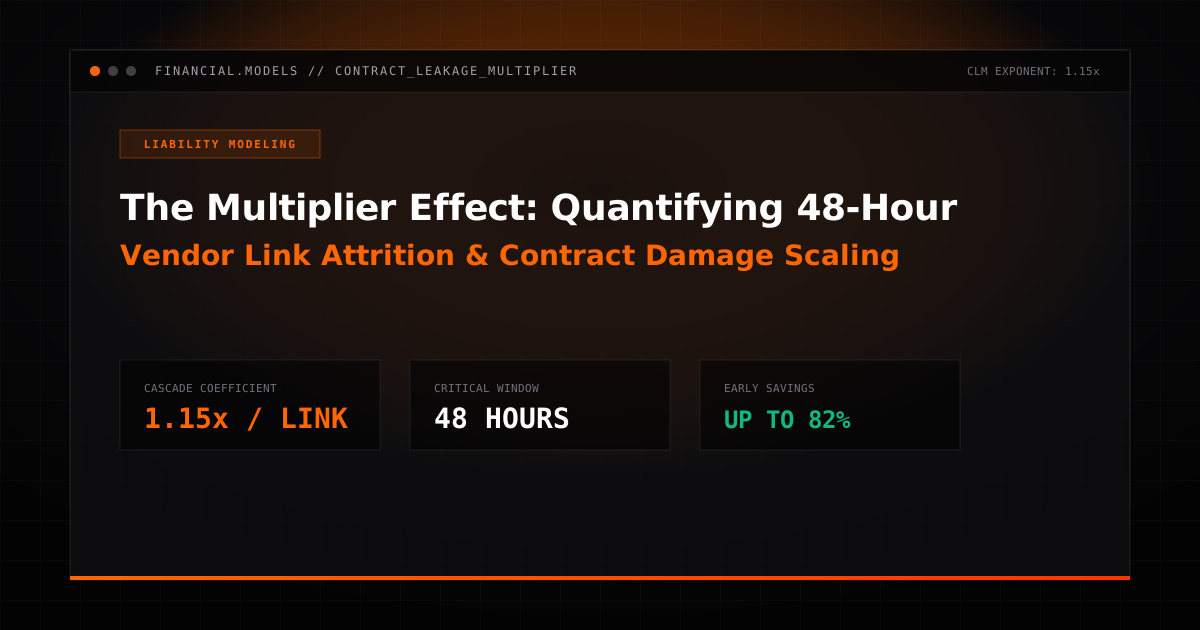
Empirical auditing across Fortune 1000 contract disputes indicates that each downstream vendor link introduces systemic legal and operational friction that amplifies primary contract breach exposure at an average compounding rate of 1.15x. The cumulative 48-hour financial exposure formula is formalized as:
Total 48-Hour Breach Liability = Average Contract Value × (Executed Vendor Links × 1.15)
For example, consider a seemingly manageable $50,000 master services agreement. If this contract is tied into 10 executed vendor links (ERP integration, hosting infrastructure, payment gateways, RevOps workflows, and outsourced delivery teams), the total breach liability escalates to:
Base ACV: $50,000
Active Vendor Links: 10
Compounding Multiplier: 10 × 1.15 = 11.50x
Total 48-Hour Balance Sheet Exposure: $575,000
You can model your organization’s exact exposure tiers in real time using our interactive Contract Breach Scaler.
The 48-Hour Forensic Window: Preventing Irrevocable Attrition
Why is the 48-hour timeframe decisive? In commercial litigation, the doctrine of prompt rescission and statutory mitigation rules impose strict duties upon corporate victims:
- Preservation of Rescission Rights: Under UCC § 2-721, delay in issuing formal notice of fraud or material misrepresentation can be construed by opposing counsel as contract affirmation or waiver of incidental remedies.
- Downstream Indemnity Deadlines: Most B2B master services agreements feature 48-to-72 hour third-party claim notification clauses. Failing to sequester tampered contracts within this window extinguishes pass-through indemnity rights.
- SEC Item 1.05 Form 8-K Compliance: Material cybersecurity and third-party data compromises trigger strict 4-day disclosure clocks following determination of materiality.
Operational Playbook for Corporate Risk & Legal Teams
- Sequester Digital Envelopes: Verify electronic signatures against cryptographic hash digests and immutable timestamp logs as outlined in our guide on Detecting Digital Signature & IP Spoofing.
- Quantify Exposure Ceilings: Run multi-variable scenario modeling in the Breach Scaler Engine before initiating bilateral dispute dialogue.
- Issue Statutory Preservation Holds: Transmit formal litigation holds to all linked vendor entities to prevent spoliation of server telemetry and electronic audit trails.